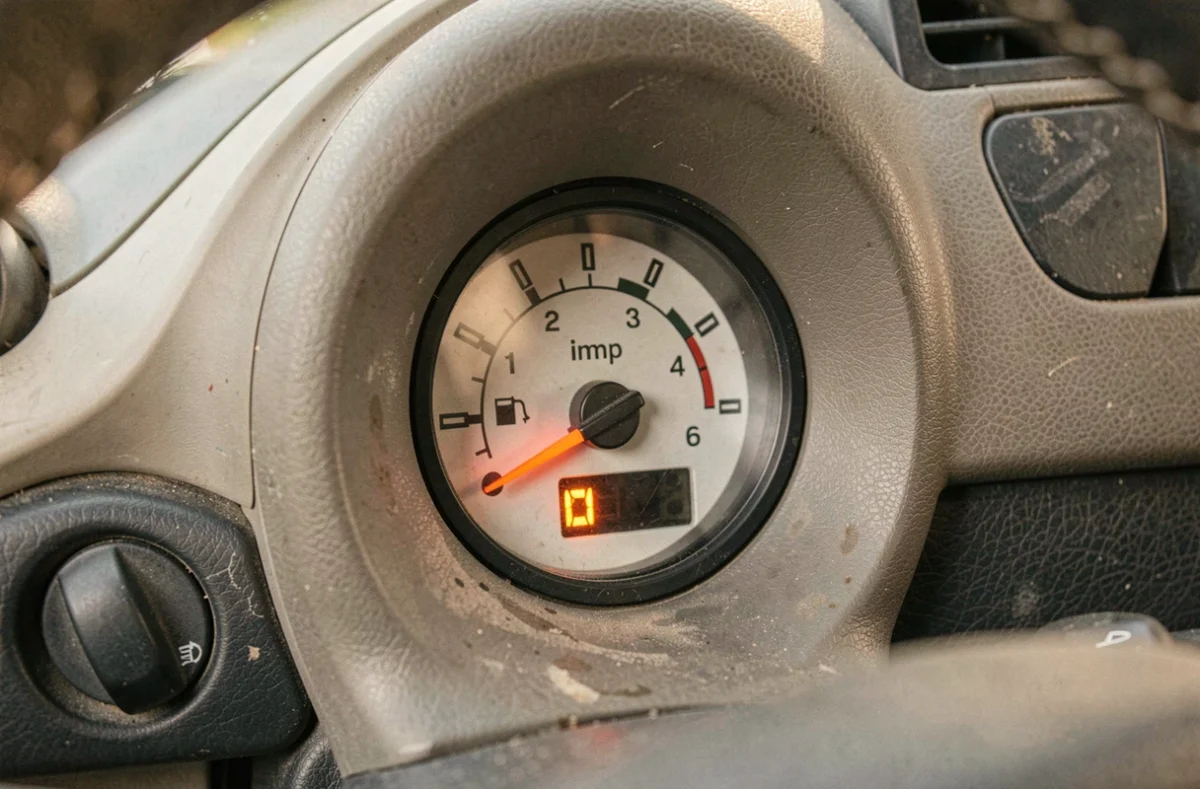
The Renault Twingo 2’s fuel gauge drops, the low-fuel warning light comes on, and the question arises: how many kilometres are left before you run out of fuel? The answer depends on the engine, driving style and type of road. This article compares the different configurations to provide a realistic estimate, rather than the overly optimistic figures often found on forums.
Fuel tank and reserve capacity by Twingo 2 engine
The Twingo 2 has the same fuel tank capacity across most petrol and diesel versions. According to owner reports and the instrument cluster readings, the low-fuel warning light indicates that only the last few litres remain in the tank.
The remaining volume is not set in stone. The fuel gauge float responds to fuel movement in the tank: a sharp turn, a slope or parking on an incline can trigger the warning light when more fuel remains, or delay it from coming on. The warning light indicates an approximate threshold, not a precise countdown.
To estimate the reserve range of a Twingo 2 in kilometres, you need to compare the remaining fuel with the vehicle’s actual fuel consumption, which varies considerably from one engine to another.
| Engine | Estimated reserve volume | Typical combined fuel consumption | Theoretical range on reserve |
|---|---|---|---|
| 1.2 petrol 16v (75 hp) | 5 to 7 litres | Varies depending on use | 70 to 115 km |
| 1.2 petrol 16v (60 hp) | 5 to 7 litres | Varies depending on use | 75 to 125 km |
| 1.5 dCi diesel (65 hp) | 5 to 7 litres | Varies depending on use | 90 to 155 km |
These wide ranges reflect reality: the difference between city driving and open roads can double the estimated range. A driver stuck in Paris traffic in a 1.2 petrol model will use far more fuel than someone driving at a steady speed on a main road.
Real-world Twingo 2 fuel consumption: factors that widen the gap
Manufacturer figures show optimistic combined fuel consumption. In everyday driving, several factors affect the Twingo 2’s fuel consumption and therefore its range once the warning light comes on.
- Average speed: above 110 km/h, the small 1.2 engine’s fuel consumption rises noticeably. Reducing your speed to 90 km/h on the road can add a few precious kilometres of reserve range.
- Route profile: stop-start city driving uses more fuel than driving on the open road. On motorways, the high, constant engine speed also penalises the 1.2 petrol, which has to rev hard to maintain speed.
- Load and air conditioning: a Twingo 2 carrying four passengers with the air conditioning on will use noticeably more fuel than when travelling alone, with the windows closed and the air conditioning off.
- Vehicle condition: underinflated tyres, a clogged air filter or worn spark plugs increase fuel consumption. In a vehicle more than ten years old, these differences are not insignificant.
The 1.5 dCi offers the best reserve range, thanks to its lower fuel consumption. The margin is narrower in petrol versions, especially in urban driving.
Twingo 2 petrol or diesel on reserve: a difference that matters
The table above shows a potential range difference of 30 to 40 km between the 1.2 petrol and the 1.5 dCi under comparable conditions. In practice, this gap widens in the city. The diesel uses little fuel under partial load and at low revs, while the small petrol engine consumes more when driven in traffic.
On motorways, however, the gap narrows. The 1.5 dCi runs at lower revs at a given speed, but the 1.2 petrol benefits from being slightly lighter. At a steady speed, the two engines have a more similar reserve range.
One point that is rarely mentioned: the Twingo 2’s trip computer (where fitted, depending on trim level) displays an estimated remaining range. This figure is based on recent average fuel consumption. If the driver has just been on the motorway and then enters the city, the estimate will be too optimistic. The range shown on the dashboard is not reliable in real time.
Mechanical risks and safety: driving a Twingo 2 on reserve
Regularly driving on reserve is not harmless to the vehicle. The fuel pump, which is submerged in the tank, uses fuel as a coolant. When the level is very low, the pump intermittently draws in air and runs hotter. In a Twingo 2 more than ten years old, a fuel pump weakened by repeatedly running on reserve will eventually fail prematurely.
Dirt and debris also build up at the bottom of the tank over the years. Running on the last few litres sends these particles towards the fuel filter and potentially on to the injectors. On the 1.5 dCi, whose high-pressure injection system is sensitive to impurities, the consequences can be costly.
Running out of fuel on the road: practical consequences
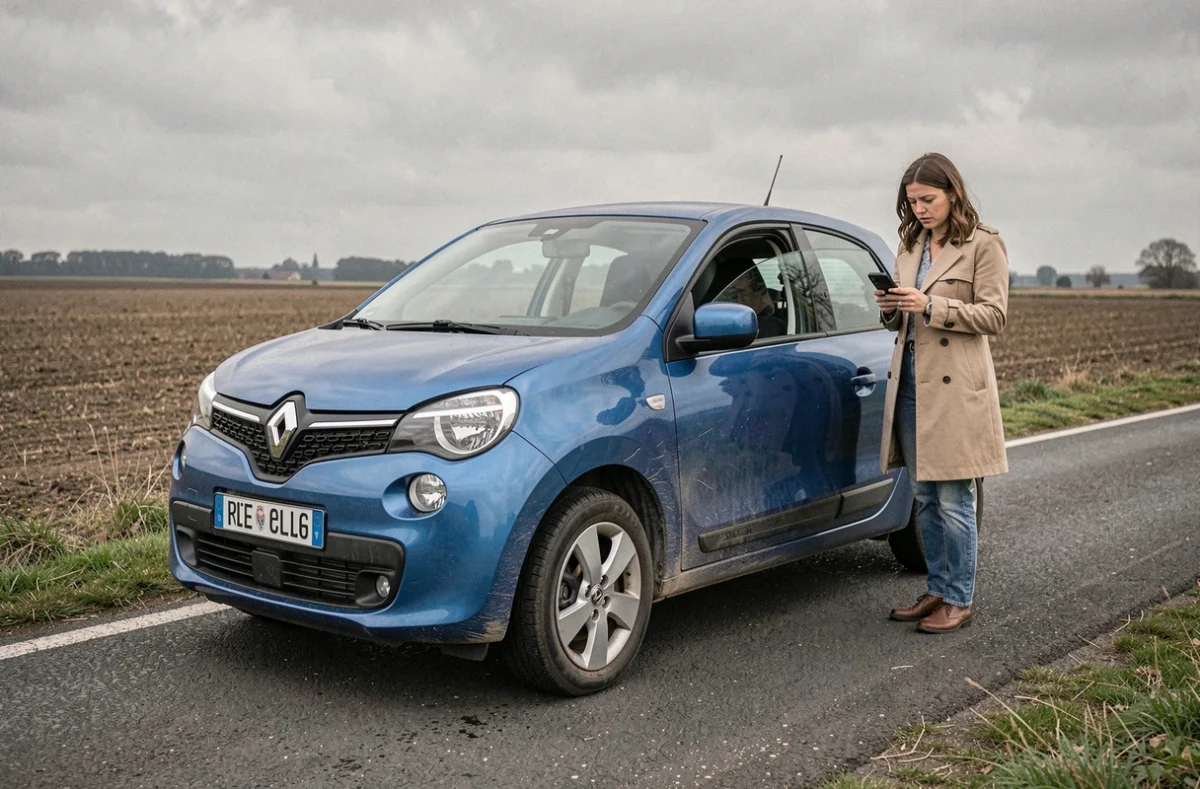
Aside from the mechanical issues, running out of fuel creates a safety hazard. A vehicle stopped on a fast road must be made visible immediately (high-visibility vest, warning triangle, hazard lights). Towing or roadside assistance incurs a charge, and on motorways, regulated breakdown service rates apply.
With a diesel engine such as the 1.5 dCi, running completely out of fuel often requires the fuel system to be primed before the engine can be restarted. This may require a mechanic if the manual priming pump is inaccessible or insufficient.
The Twingo 2 petrol offers between 70 and 125 km on reserve, depending on the version and conditions; the 1.5 dCi offers between 90 and 155 km. These figures are only estimates: the only reliable approach is to treat the low-fuel warning light as a signal to refuel immediately, not as the start of one last marathon.